₹1,500 Discount on Combo Course
Grab Now Apply "FLAG26"
How TallyPrime's API Ecosystem and Third-Party Integrations Help Your Business?
TL;DR
TallyPrime’s API ecosystem and third-party integrations bridge the gap between your business management software and other business tools like CRMs and e-commerce platforms. By automating data flow, these connections eliminate manual entry, eliminate errors, and save hours of administrative work every week. You don't need to rip out and replace your accounting software when your business outgrows standard workflows. You can use Tally Definition Language (TDL) and TallyPrime’s API ecosystem to customize screens, vouchers, and reports, and connect external apps, building directly on your TallyPrime setup instead of starting over.
Introduction
In my experience working with growing businesses, the biggest bottleneck is rarely a lack of sales or hard work, it is the invisible time lost moving data between different apps. If your sales team uses one tool, your warehouse uses another, and only your accountant relies on TallyPrime, you likely spend hours copying information back and forth.
An API (Application Programming Interface) simply acts as a secure digital bridge, allowing your favorite software tools to talk directly to TallyPrime without manual intervention.TallyPrime is capable of integration with other tools to ease your workflow and save substantial time for your business.
Let’s find out how TallyPrime’s API ecosystem and third-party integrations help your business grow without switching systems.
Why is manual data entry holding your team back?
We’ve all been through month-end closing chaos: team members sitting late into the evening, manually matching Excel sheets, typing invoice numbers, and hunting down missing receipt entries.
When your business uses disconnected systems, human error naturally creeps in. A single typo in an inventory number or a missed customer payment can throw off your entire ledger. More importantly, it traps your team in repetitive admin tasks instead of letting them focus on growing your business. Connecting your software ecosystem means your team works faster with accurate numbers and zero errors.
What Can TallyPrime Actually Connect With?
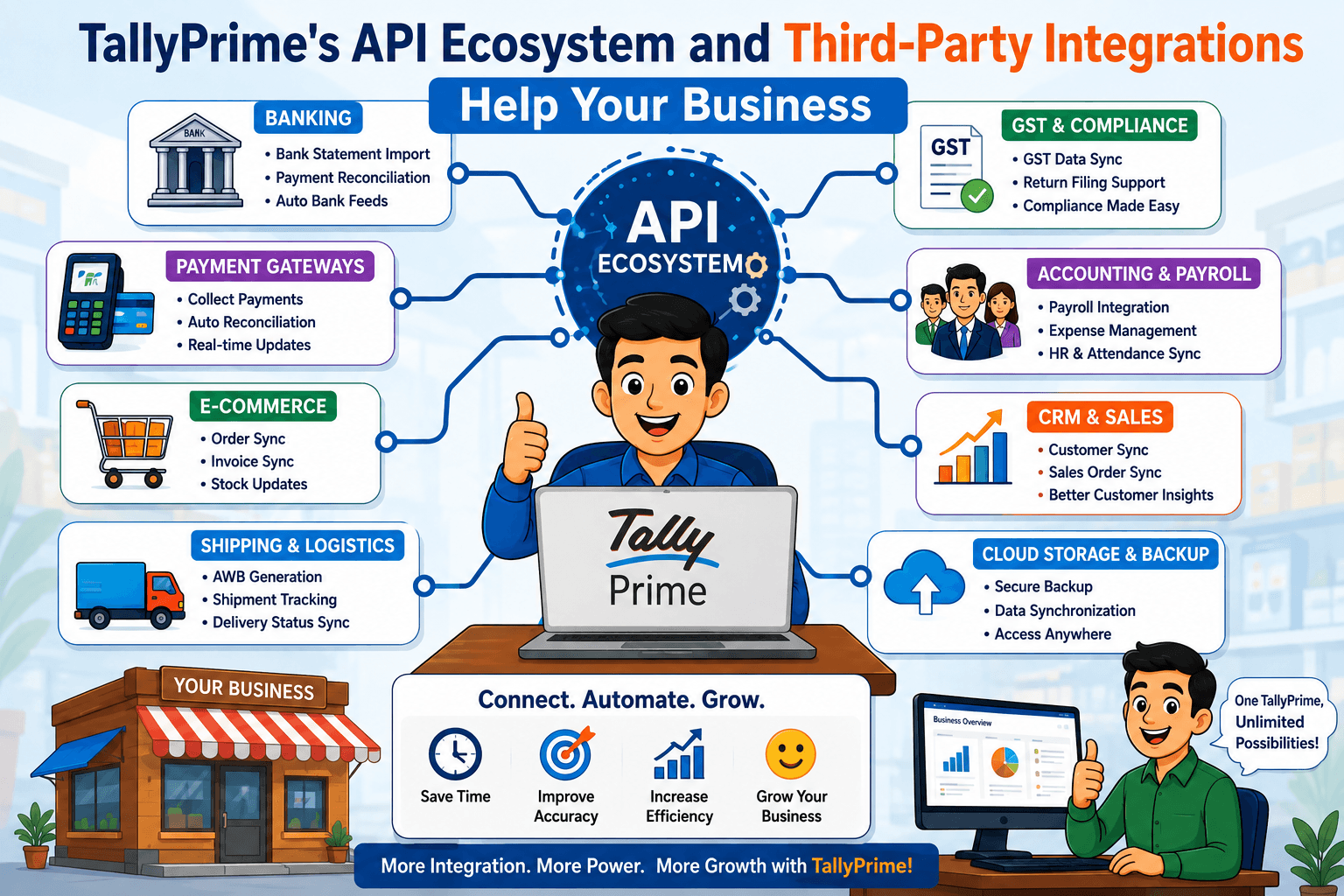
TallyPrime connects with a wide array of third-party business systems, government portals, banking networks, and developer technologies to unify workflows and eliminate manual data entry.
Business Software & Applications
● CRM Systems: Syncs customer data, sales pipelines, and lead conversions directly into accounting entries.
● E-Commerce Platforms: Integrates with online storefront marketplaces to automatically pull orders, inventory changes, and customer billing.
● ERP & Custom Industry Apps: Connects with specialized software for manufacturing, supply chain, and warehouse operations.
● Payroll & HR Software: Automatically reflects employee compensation and deductions in financial books.
Government & Statutory Portals
●GST & E-Invoice Portals (IRP): Directly communicates with government portals to automatically generate, upload, authenticate, and print Electronic Invoice IRNs and QR codes.
● E-Way Bill Systems: Seamlessly generates e-way bills for goods transit without manual entry on external sites.
Banking & Digital Payments
● Connected Banking: Integrates directly with major banks (such as SBI, ICICI, Axis Bank, and Kotak Mahindra Bank) for real-time balance checks, direct fund transfers, and automated bank reconciliation.
● Payment Gateways & UPI: Connects with platforms like Razorpay and PayU to embed dynamic payment links and UPI QR codes straight onto digital invoices and reports.
API Integration vs. TDL Customisation: What's the Difference?
API Integration and TDL (Tally Definition Language) Customisation represent two fundamentally different approaches to extending TallyPrime's capabilities, depending on whether you are communicating with external systems or modifying the software internally.
TDL Customisation
● Primary Purpose: Modifying the internal user interface, creating custom reports, adding new data fields, or automating workflows entirely within the Tally ecosystem.
● Architecture: Proprietary development language native to Tally. It allows you to rewrite or extend the existing database schema, entry screens, and UI layouts.
● Data Flow: Operates locally inside TallyPrime. Data stays within the application environment unless exported.
Best Used For: Tailoring data entry forms to match specific business needs, building specialized management reports, or adding custom validation rules during voucher creation.
API Integration
● Primary Purpose: Connecting TallyPrime to third-party external applications (such as CRMs, e-commerce stores, custom mobile apps, or BI tools) for seamless data exchange.
● Architecture: Uses standard communication protocols and formats (JSON, XML, and HTTP requests) to send and receive data programmatically without needing direct UI interaction.
● Data Flow: Two-way or one-way synchronization bridging Tally and outside databases over a local network or cloud connector.
Best Used For: Automatically pushing web store orders into Tally as sales invoices, syncing CRM customer data, or pulling real-time inventory and financial summaries into external business dashboards.
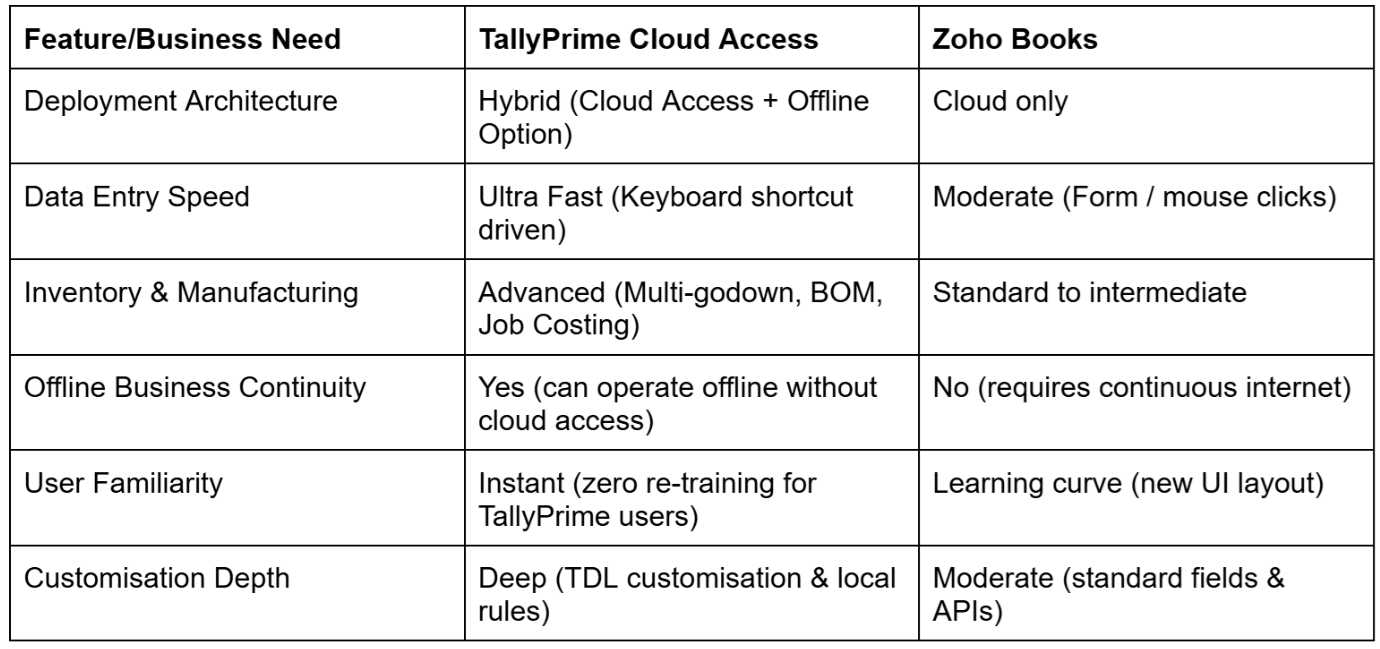
Comparison Overview
How do third-party integrations change daily operations?
Third-party integrations fundamentally shift daily operations from manual, siloed administrative tasks to automated, real-time workflows.
Elimination of Administrative Bottlenecks: Routine data entry tasks—such as re-keying e-commerce orders, copying CRM customer records, or typing bank statements—are fully automated, freeing up staff to focus on revenue-generating work.
Real-Time Cross-Department Visibility: Silos between departments disappear. When sales closes a deal in an external CRM or procurement updates inventory in a warehouse app, the financial impact instantly updates in TallyPrime without waiting for end-of-day batch exports.
Frictionless Compliance and Dispatch: Generating statutory documents like e-invoices and e-way bills becomes an integrated part of raising a voucher, preventing shipment delays and compliance mismatches on government portals.
Accelerated Cash Flow Cycles: Connected banking and automated digital payment links embedded in invoices allow finance teams to track receipts, execute direct vendor payouts, and match bank books in minutes instead of days.
Error-Free Data Integrity: Automated data pipelines eliminate human transcription mistakes, ensuring that stock levels, tax calculations, and ledger accounts remain accurate across all systems.
How TDL Customization and Integration Make TallyPrime Work Your Way?
In my experience, one of the biggest complaints business owners have about standard software is that it forces them to change their processes to fit the tool. Every industry, whether its retail, manufacturing, or distribution, has its own unique rhythm, special reporting needs, and custom workflows.
How does TDL let you build on your existing setup?
TDL is Tally’s native development language. Think of it as a toolkit that lets you reshape how TallyPrime looks and behaves without touching the core accounting engine.
● Tailor Screens and Vouchers: Add custom fields, like delivery vehicle numbers, project codes, or approval checkboxes, right onto your regular entry forms.
● Build Extended Reports: Create specialized management reports that track metrics unique to your industry, eliminating the need for messy side-spreadsheets.
● Enable Smooth Data Exchange: Connect external web portals, CRMs, or inventory tools so data flows directly into your custom Tally fields without manual re-typing.
What does an API look like in the real world?
Omnichannel Retail E-Commerce
A mid-sized retail client I worked with last year, was running an online storefront alongside two physical retail branches. Every morning, an operations assistant spent nearly three hours downloading website sales reports and manually re-entering hundreds of individual transactions into TallyPrime.
By setting up a direct API connection between their e-commerce platform and TallyPrime, those orders began flowing straight into the books the moment a customer checked out. The three-hour morning data chore vanished completely. Not only did their error rate drop to nearly zero, but their team could also ship orders hours faster than before.
Industrial Manufacturing & Distribution
A mid-sized industrial equipment manufacturer utilizes TallyPrime connected with a custom warehouse management app and vendor portals. When raw materials are scanned into the factory floor, the inventory app updates stock levels and triggers purchase order matching through Tally's API. Simultaneously, when finished goods are packed for dispatch, TallyPrime instantly communicates with the government IRP portal to generate the e-way bill and e-invoice, embedding the IRN QR code directly onto the delivery challan. This automation bridges shop-floor operations with statutory compliance, preventing dispatch bottlenecks and ensuring accounts payable and receivable reflect goods movement in real time.
Conclusion
Streamlining your business doesn't always mean buying a new enterprise software. Often, it simply means making the tools you already use work better together. Start by auditing your daily routine: identify the one report or entry task that wastes the most time, and explore how a smart integration can take it off your plate.
Quick Checklist to Get Started:
● Map Out Your Bottlenecks: Identify which repetitive tasks consume the most manual hours—whether it is re-entering e-commerce orders, chasing collections, or cross-matching bank statements.
● Audit Existing Software Stack: List out the CRM, e-commerce platforms, banking portals, and logistics tools your business currently uses to see where data silos exist.
● Choose Your Integration Path: Decide whether you need standard API connectors for external apps or TDL customisations for internal screen and workflow modifications.
● Verify Compatibility & Security: Ensure your chosen connectors support secure protocols (like REST APIs, JSON, or XML) and comply with data privacy standards.
● Test in a Sandbox Environment: Run a pilot phase with a small subset of data (such as a single branch or product line) to verify synchronization accuracy before a full company-wide rollout.
● Train Your Team: Educate staff on the new automated workflows, focusing on exception-handling and how to read real-time dashboards.
Frequently Asked Questions
What is a TallyPrime API?
An API is a secure communication channel that allows TallyPrime to exchange data automatically with other external apps and software.
What is Tally Definition Language (TDL)?
TDL is Tally’s proprietary programming language used to customize, extend, and integrate features within TallyPrime.
Do I need advanced coding skills to use integrations?
No. Ready-to-use integration plugins and connectors are available for popular business applications and don’t require coding skills.
Is my financial data safe during API integration?
Yes. Trusted integrations use secure, encrypted protocols and role-based access controls to keep your financial records fully protected.
Can TallyPrime connect with my e-commerce website?
Yes, TallyPrime can connect via APIs to sync online sales orders, customer details, and inventory levels automatically.
Will integration help reduce month-end closing stress?
Absolutely. By automating daily entries and reconciliation, your ledger stays updated continuously, making month-end closing much faster.
Is it expensive to build custom TDL solutions?
Compared to buying and implementing an entirely new enterprise software suite, TDL customizations are generally much faster and more cost-effective.