₹1,500 Discount on Combo Course
Grab Now Apply "FLAG26"
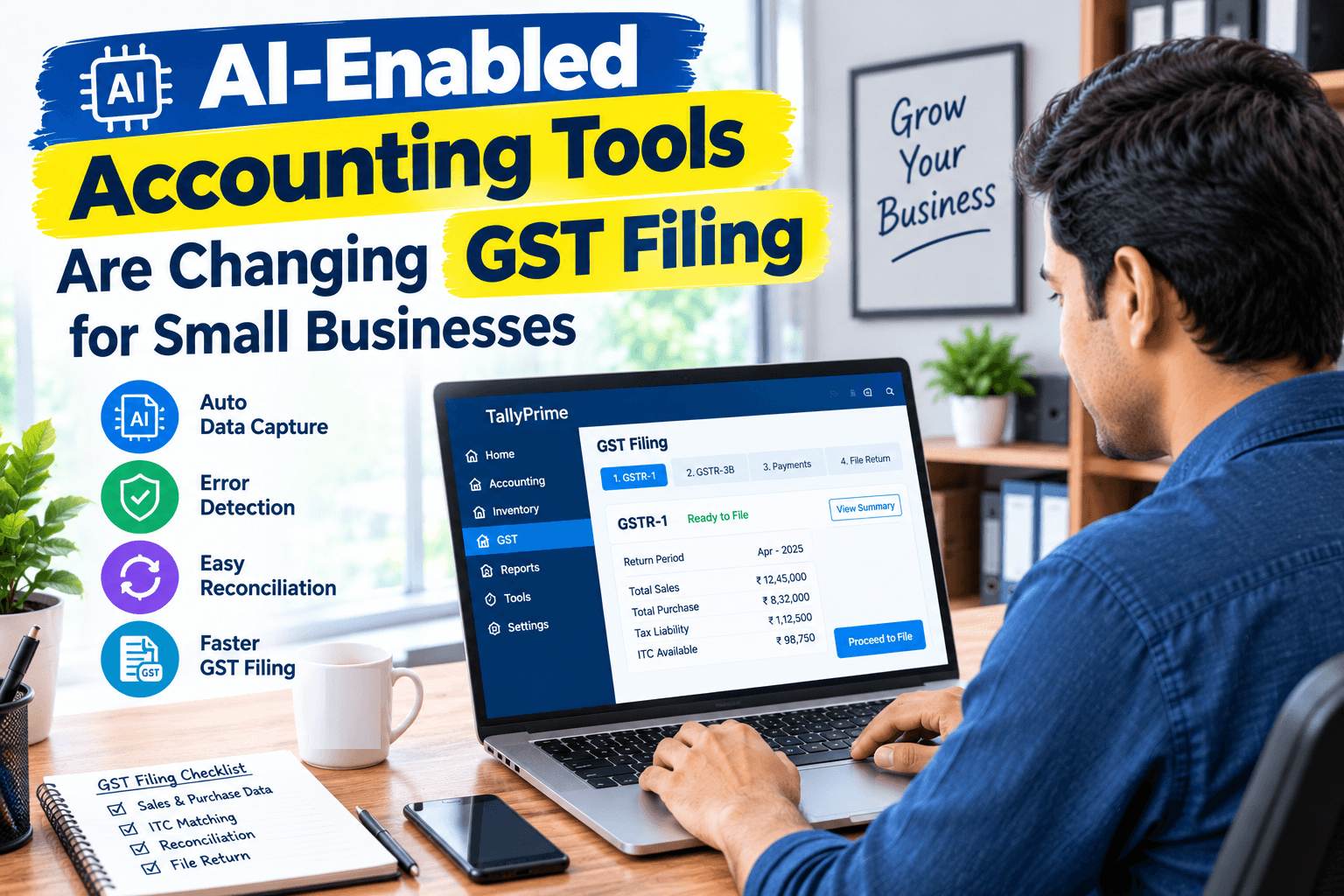
How AI-Enabled Accounting Tools Are Changing GST Filing for Small Businesses
30-Second Summary
GST filing can become stressful when sales invoices, purchase bills, ITC data, and GST returns do not match. AI-enabled accounting tools are changing this by helping businesses capture data faster, identify errors, reconcile information, and prepare cleaner GST data before filing. The biggest benefit is not simply saving time. It is reducing the small mistakes that create bigger problems during reconciliation and return filing.
Are AI-enabled accounting tools really changing GST filing?
AI is making GST work more organised, less manual, and easier to review before filing.
Earlier, many small businesses depended heavily on Excel sheets, manual data entry, and repeated checking. Today, AI-enabled accounting software helps bring invoice data into the system, identify unusual entries, and make reconciliation easier and quicker.
This does not mean the business owner can simply click a button and forget about GST.The real advantage is that AI can take care of repetitive data-related work, accuracy, and errors while the accountant focuses on checking and making decisions.
Why Is Manual GST Filing Holding Small Businesses Back?
For years, traditional bookkeeping meant manually punching data from paper bills or scattered PDFs into accounting ledgers. When tax season rolled around, a single typo in an HSN code or GSTIN number meant a rejected return or a mismatch notice.In my work with local retailers and service providers, I’ve seen teams spend entire weekends cross-checking data. It drains time, delays payments, and creates unnecessary stress.
How Do AI Tools Take the Pain Out of Invoice Matching?
One of the biggest hurdles in GST compliance is matching your outward supplies with your inward tax credits (reconciling GSTR-1 with GSTR-2B). AI-powered tools use smart optical character recognition (OCR) and machine learning to scan invoices, read vendor details, and automatically align them with government portal data.
Smart Insight: Rather than manually flagging a missing invoice from a supplier, modern AI tools run background checks continuously, highlighting discrepancies in real time before you hit submit.
Can Small Business Owners Use AI Without Technical Training?
A common misconception is that AI is meant only for large corporations with massive IT budgets. Modern business management software is designed for everyday business owners.

You do not need to write code or understand algorithms. If you can use a messaging app on a smartphone, you can easily use business management tools like TallyPrime. The software automates your tax calculations and prepares your returns for filing.
How does TallyPrime reduce GST filing errors at the point of every transaction?
TallyPrime reduces GST filing errors by treating compliance as a natural, built-in byproduct of everyday bookkeeping rather than a separate, end-of-month scramble. By capturing clean, structured data right at the point of transaction, it eliminates the gaps where human mistakes usually creep in.Here is how its transactional architecture ensures accuracy:
1. Unified Voucher-Based Entries (Zero Disconnect)
In many businesses, inventory management and tax filing live on two separate tracks, resulting in mismatched numbers. TallyPrime links them into a single voucher.
- When you record a purchase or sale, the software simultaneously updates your stock ledgers, calculates the tax, and logs the details into your GST returns.
- If you record a purchase receipt, it instantly captures the supplier’s GSTIN, HSN/SAC code, and Input Tax Credit (ITC), meaning your warehouse logs and tax registers can never accidentally fall out of sync.
2. Automated Tax Calculations and Rate Application
Manual tax calculations are a primary source of filing errors. TallyPrime automatically applies the correct tax rules based on transaction parameters:
- It identifies whether a transaction is intra-state (CGST + SGST) or inter-state (IGST) based on the customer or vendor's location.
- It pulls pre-configured HSN/SAC codes and tax rates directly from item masters, removing the risk of manual selection typos during billing.
3. Built-In Smart Error Detection
TallyPrime checks data validity while you type, rather than waiting for you to upload files to the government portal. Its built-in error detection flags issues such as:
- Incomplete vouchers or missing mandatory fields.
- Incorrect or invalid customer/vendor GSTIN formats.
- Mismatched tax ledgers or unmapped items.
- Fixing these alerts proactively prevents rejections on the GST portal.
How 'Docs by Ira' helps small business owners with automation and GST filing.
Docs by Ira is an AI-powered invoice processing and document automation feature built directly into TallyPrime. It is designed to remove the friction of manual bookkeeping and streamline GST compliance for small and medium-sized businesses (SMBs).
Here is a breakdown of how it helps small business owners with automation and GST filing:
1. Eliminating Manual Data Entry with AI OCR
- How it works: Instead of manually typing out vendor names, invoice numbers, dates, HSN/SAC codes, and tax breakdowns, business owners or their accountants can simply upload a photo, handwritten, or printed invoice (PDF or image) via the mobile app or desktop. Not only that, it can also import PDF bank statements directly into Tally.
- The Benefit: Docs by Ira automatically reads the document and extracts all critical accounting and GST details to generate draft vouchers within seconds, cutting manual data entry effort by up to 80%.
2. Streamlining GST Compliance and Accuracy
- Accurate Tax Fields: By pulling tax parameters such as CGST, SGST, IGST values, tax rates, and party GSTINs, straight from the invoice, it minimizes human typing errors.
- Foundation for Clean Returns: Clean data entry is the backbone of smooth GSTR-2B reconciliation and Input Tax Credit (ITC) claims. By capturing data accurately from the source, it prevents mismatched tax credits and subsequent government notices.
3. Intelligent Exception Handling and Duplicate Checks
- Spotting Discrepancies Early: If an invoice has a missing GSTIN, a blurred amount, or a mismatch, the tool automatically flags these exceptions so you can review them before the voucher hits your final books.
- Preventing Double Entries: The system detects duplicate invoices, saving businesses from accidentally recording and claiming taxes on the same bill twice.
4. Bulk Processing for Peak Filing Seasons
- Batch Workflows: Month-end and quarter-end filing deadlines often cause severe bottlenecks. Docs by Ira supports bulk invoice uploads, allowing businesses to process dozens or hundreds of documents simultaneously and generate draft entries in minutes instead of days.
5. Smart Master Mapping
- Learning Over Time: The AI intelligently maps incoming vendor names and stock items to your existing Tally masters. If a new vendor or item appears, it can automatically create a new master, and it "remembers" corrections for future cycles to speed up subsequent bookkeeping.
A Real-World Shift: From Midnight Panic to One-Click Filing
I worked with Rahul, a hardware distributor in Delhi. Every quarter, Rahul’s small team spent late nights manually sorting hundreds of supplier bills and payment receipts. During one filing cycle, a minor data-entry oversight caused a massive tax credit mismatch that triggered an official notice.
Frustrated with the existing process, Rahul adopted 'Docs by Ira' for TallyPrime. This AI automatically extracted accounting and stock data from uploaded vendor PDFs and instantly identified incorrect GSTINs.
"We went from dreading the 20th of every month to finishing our GST review in under an hour," Rahul shared with me recently. His team reclaimed valuable hours to focus on sales rather than paperwork.
Conclusion
AI-enabled accounting tools are making GST filing easier for small businesses by reducing manual work, organising invoice data, helping identify errors, and simplifying reconciliation.
Instead of spending hours managing repetitive GST-related tasks, business owners and accountants can use AI to process data faster and focus on reviewing important exceptions and making informed decisions.
As GST compliance becomes increasingly digital, AI-enabled accounting can help small businesses make their GST filing process faster, more organised, and less error-prone, while keeping human review at the centre of the process.
FAQs
1. Can AI replace an accountant for GST filing?
No. AI can handle repetitive tasks and highlight issues, but professional review is still important before finalising GST data and filing returns.
2. Can AI identify GST invoice errors?
AI-enabled software such as TallyPrime’s Docs by Ira can flag unusual or inconsistent invoice information, helping accountants identify transactions that require further checking.
3. Does AI make GST reconciliation faster?
Yes. AI reduces manual comparison work by organising accounting and GST-related information, allowing accountants to focus on investigating unmatched transactions.
4. Should small businesses use AI in TallyPrime for GST accounting?
Yes, using AI for GST accounting can be helpful for businesses with regular invoice volumes, repetitive accounting work, and reconciliation challenges, provided proper review controls are maintained.
5. What should businesses check before using AI accounting tools?
Businesses should check data accuracy, review controls, reconciliation features, audit trails, GST functionality, and how well the tool fits their existing accounting workflow.